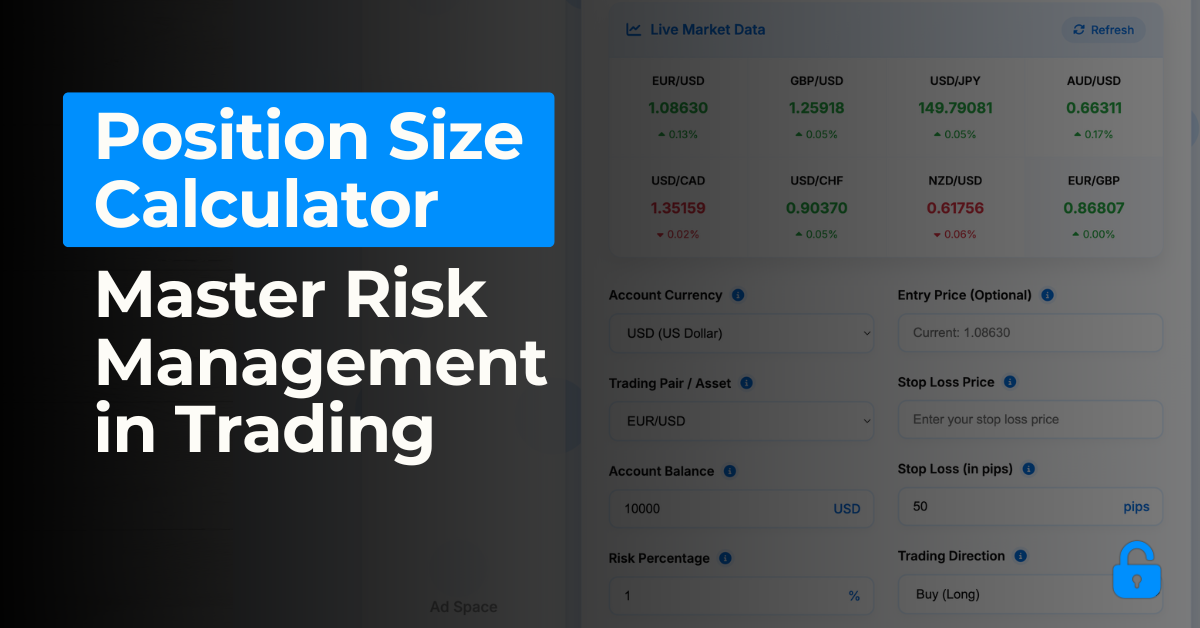
Position Size Calculator: Master Risk Management in Trading
Introduction
In trading, your win or loss isn't necessarily right or wrong—more about how much you bet on each trade.
Even the most skilled traders can blow a trading account if they put too much capital into one trade. Position sizing comes into play here.
A position size calculator is your risk management buddy. It tells you exactly how many units, lots, or shares to trade so that you stay within your risk parameters, no matter how good a setup looks.
Here, you'll find out what position sizing is, why it's essential, how to calculate it step-by-step, and how to implement it as a basis for your risk management trading plan.
What is Position Sizing in Trading?
Position sizing is the process of determining how much of a particular asset to trade based on:
- Your account balance
- The amount of risk you’re willing to take
- Your stop-loss distance
Think of it as the safety belt in your trading car—you can still drive fast, but you’re protected if the market takes a sudden turn.
Why is a Position Size Calculator Important?
A position size calculator removes guesswork from trade risk control.
Here’s why it’s essential:
- Prevents over-leveraging – Keeps you from opening trades too large for your account.
- Maintains consistent risk – Risk the same % per trade for smoother equity curves.
- Removes emotion – Numbers decide, not impulses.
Without proper position sizing, a few bad trades can wipe out months of progress.
How to Calculate Position Size (Step-by-Step)
Formula:
Position Size = (Account Balance × Risk %) ÷ (Stop Loss in Pips × Pip Value)
Step 1: Decide your account risk percentage (e.g., 1% or 2%).
Step 2: Identify your stop-loss distance in pips.
Step 3: Find the pip value for your trading pair.
Step 4: Apply the formula to determine lot size.
Worked Example with Real Numbers
Let’s calculate position size for:
- Account Balance: $10,000
- Risk: 1%
- Currency Pair: EUR/USD
- Stop Loss: 50 pips
- Pip Value (per standard lot): $10
Step 1: Risk Amount = $10,000 × 0.01 = $100
Step 2: Position Size = $100 ÷ (50 × $10) = 0.2 lots
✅ This means you should trade 0.2 standard lots to risk exactly $100 on this setup.
Benefits of Using a Position Size Calculator Tool
- Accuracy: Eliminates manual errors.
- Speed: Calculate trade size instantly.
- Consistency: Applies the same rules every time.
- Adaptability: Works for forex, stocks, and commodities.
Popular Position Size Calculator Tool Online
- Pipslock Position Size Calculator – Fast and forex-friendly.
How Position Sizing Fits into Overall Risk Management Strategy
Position sizing is just one piece of a complete risk management plan. Combine it with:
- Proper stop-loss placement
- Diversification
- Risk/reward ratio discipline
- Avoiding overtrading
Think of it as controlling the size of the waves you surf—big enough to make a splash, small enough to avoid drowning.
Final Thoughts & Best Practices
If you take anything away from this article, let it be this: Your position size determines your survival in trading.
Without it, any effective strategy will fail.
Best Practices:
Risk 1–2% per trade for account longevity.
Always use a stop loss.
Recalculate position size if account balance changes.
Start using a position size calculator on every trade and get into the habit of managing risk. Your future self will thank you.